Package Management
Package Management Process Overview
Package Management provides capabilities for creating, managing, changing and tracking various types of Packages of information for a Project. A Construction Package is created to hold the master set of documents that will be sent out to each Organization on the Construction Package. Individual Packages are created to store communications and files specifc to each Package Organization in the Construction Package. Package Organizations are notified along the way via e-mail as the Package progress through its lifecycle. Notification relies on configurable e-mail templates.
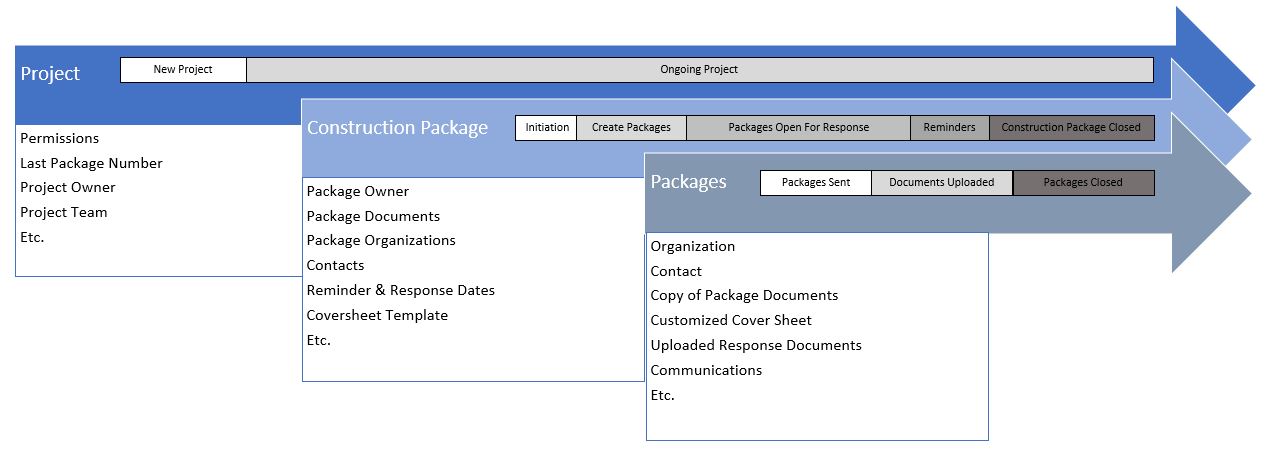
The purpose of this User Guide is to provide documentation over each part of the system and explain how each part of the system works. Overall, the steps to the Package Management process are:
- Create a Construction Package to contain
- Organizations that will be invited to Package
- Contacts from each organization responsible for preparing the Package response
- Reminder and due dates
- Documents from the Project that provide information necessary for the Package Organization to respond
- Common documents that are not Project specific such as corporate policies, response procedures, etc.
- A Package cover sheet template used to generate custom Package Cover Sheets for each Package Organization
- Create Packages for each Organization on the Construction Package
- Send the Packages to the Organizations
- Subcontractors Accept or Decline to respond
- Subcontractors prepare and upload responses
- Packages are reviewed
- The Package is manually marked Complete
Importantly, the steps above are one example of a high level path through the process. The system allows for variations of this path including communications, document changes, and several other features to handle the challenges of managing Packages through a controlled process. The sections below are used to describe each part of the process.
Initial Package Management Configuration
The Package Management system uses "templates" to provide a customizable set of e-mail messages as well as a personalized Cover Sheet to each Construction Package. The system comes with a set of Global templates. These templates are used across the corporation for all Projects and Construction Packages unless templates have been specified for a Project or Construction Package within a Project by setting the Project and Construction Package metadata property.
All Package Management Configurations Files are located within the following view path
Construction Management | Configuration Files
Only members of the Package Manager group are allowed to see the Construction Management views.
Project Configuration
Projects within the Construction Management solution include basic information about a project necessary to control the Bid Managment solution. The Project can be expanded to meet the needs of the organization by adding new properties as needed.
To create a new Project use the M-Files Create menu and choose Project. The purpose for each property on the Project is outlined below.
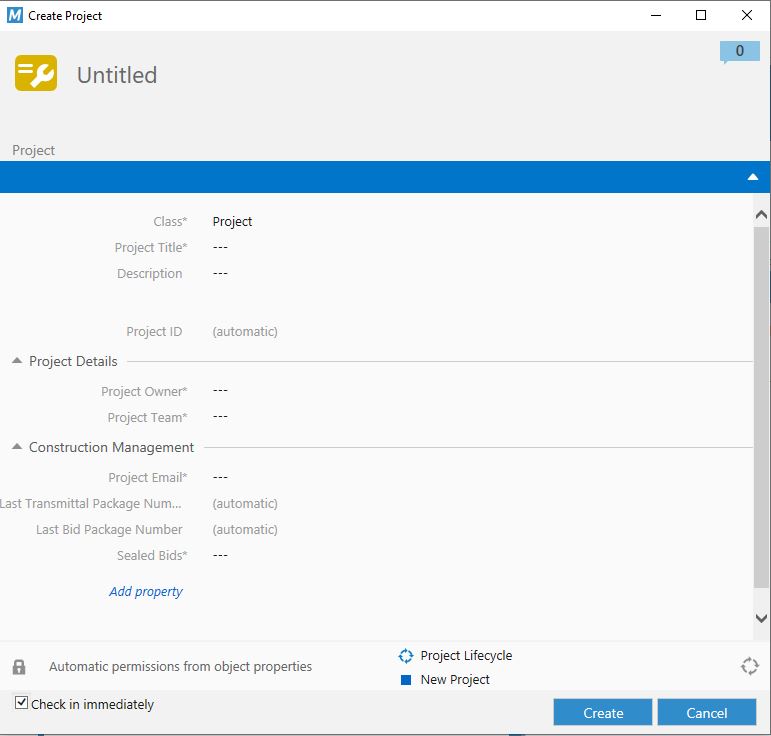
- Project Information
- Project Title - This will be the name of the Project. It will be used in e-mails, reports, etc. A long name can cause word wrapping and cluttered appearances.
- Description - This is a free form description of the Project and is not used other than within the Project object itself.
- Project ID - The ID assigned to the Project is a unique number that increments with each new Project created. In cases where Projects get created and subsequently deleted, new projects will increment and there will be a gap in the numbering.
- Project Details
- Project Owner - This is the person who is responsible for the Project. The Project Owner will have permissions to change and delete the Project.
- Project Team - These are the Team Members who will be working on the Project. Team Members will have access to Project Information but not be able to change the Project.
- Construction Management
- Project E-Mail - This is the e-mail address that will appear in the From address on automated e-mail messages.
- Last Construction Package Number - If the Package module is licensed, this will track the last Package Number issued. It is an automated value.
- Last Bid Package Number - This will track the last Bid Package Number issued. It is an automated value.
- Sealed Bids - This serves as a default value for all Bid Packages created for the Project. If this is set to Yes, any documents uploaded will be Restricted until after the Bid Package closes.
Setting the Project Owner and Project Team is important to insure only those with the correct permissions are able to access Project information. Once set, these permissions determine who can access and create objects within the system.
Package Cover Sheet Template
A Package Cover Sheet Template is a special Document Class (Package Cover Sheet) which also has the Is Template flag checked. This document is used by Package Management to generate a personalized Package Cover Sheet to each Organization listed in the Construction Package.
Package Cover Sheet Templates are found within the following View Path:
Construction Management | Configuration Files | Package Cover Sheet Templates
Each Package Cover Sheet Template within the system is shown here. Initially there will be only a single file which serves as a default across the organization. It will only have the Class, Title and Is Template property specified as shown here.
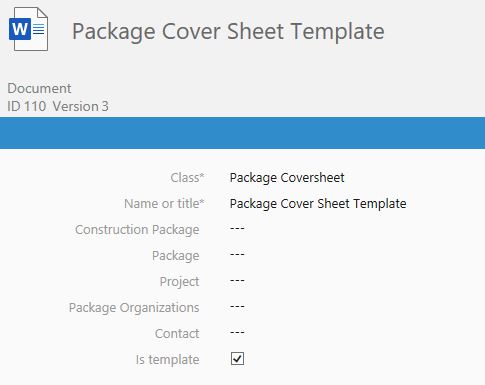
A Package Cover Sheet Template with no Project or Construction Package specified should always exist on the system. This document serves as the default Package Cover Sheet Template across the entire organization. Copies of this document can be made for each Project or even for each Construction Package if desired. This allows Project specific branding and Cover Sheets. As with all M-Files templates, these documents can reference properties on the metadata card and any the properties of any objects referenced by the metadata card.
Only the Class, Cover Sheet Title, Project and Construction Package should be specified on Package Cover Sheet Templates. All other information is populated automatically by the system when Cover Sheets are created.
E-Mail Templates
E-Mail Templates are HTML files that the system uses as Templates when creating and sending e-mails to Subcontractors. Modifying these files provides the ability to format outgoing e-mail messages to match corporate branding standards.
E-Mail Templates are found within the following View Path
Construction Management | Configuration Files | E-Mail Templates
Each E-Mail Template within the system is shown within this view. Initially there will be a single E-Mail Template for each Event which will generate an outgoing e-mail message. Each E-Mail Template will only have the Class, Title and optionally the Email Images property set as shown here.
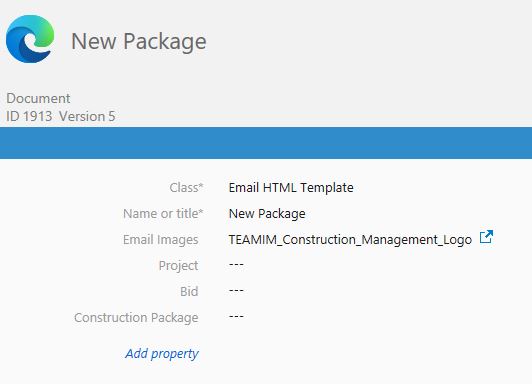
An E-Mail Template with no Project or Package specified should always exist on the system for each Event. This document serves as the default Template across the entire organization. Copies of this document can be made for each Project if desired. This allows Project specific branding on all outgoing correspondence.
E-Mail Templates are not the same as M-Files Document templates. They are HTML files and you should well versed in HTML if you choose to modify them. There are two things about these files which make them different than a standard HTML file.
- Image References - All images that are refernced by the HTML E-Mail Template must be specified in the EMail Images property on the metadata card for the template as shown above.
<img border="0"	class="center autowidth" src="TEAMIM_Construction_Management_Logo.png"
	style="text-decoration: none; -ms-interpolation-mode: bicubic; height: auto; border: 0; width: 100%;
           max-width: 310px; display: block; Margin: 30px auto 20px auto;"
	width="310" />
- Body Text - Static body text can be added into the EMail template, however only a single block of body text can contain variables from the Construction Package. This block of text is referenced by the {{BODY}} tag within the HTML. When the E-Mail is generated the {{BODY}} tag will be replaced with configuration for the E-Mail Body associated to this particular Event found in the Administrator Tool. The configuration in the Administration tool allows a mix of HTML and references to Package Management Properties as shown here for the Package Creation Event.
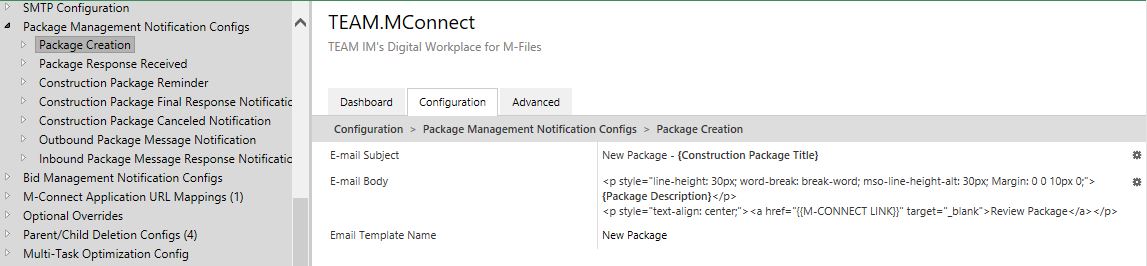
Please reference the Administrator Guide for more information.
E-Mail Template Images
E-Mail Template Images are image files that are stored in M-Files as class EMail Template Image and are referenced by E-Mail Templates. These images are used to add branding and visual impact to outgoing e-mail messages from the system. Since these images will ultimately be formatted within an e-mail message, care should be taken when sizing them.
E-Mail Template Images are found within the following View Path
Construction Management | Configuration Files | E-Mail Template Images
Each image that can be referenced on an E-Mail Template is shown within this view.
Only files of type jpg, JPEG, PNG, GIF, APNG, SVG, BMP, ICO are allowed within E-Mail Templates
Common Package Documents
Common Package Documents are those documents which will be shared across Projects and Construction Packages. Examples may include legal notices, safety information, etc. These documents are created using standard M-Files functionality.
Common Package Documents are found within the following View Path
Construction Management | Configuration | Common Package Documents
Construction Packages
Construction Packages are created for each group of work that needs to be sent to subcontractors for review and completion. The Construction Package includes refences to Organizations, Contacts, Project Documents standard company documents as well as Reminder and Due Dates.
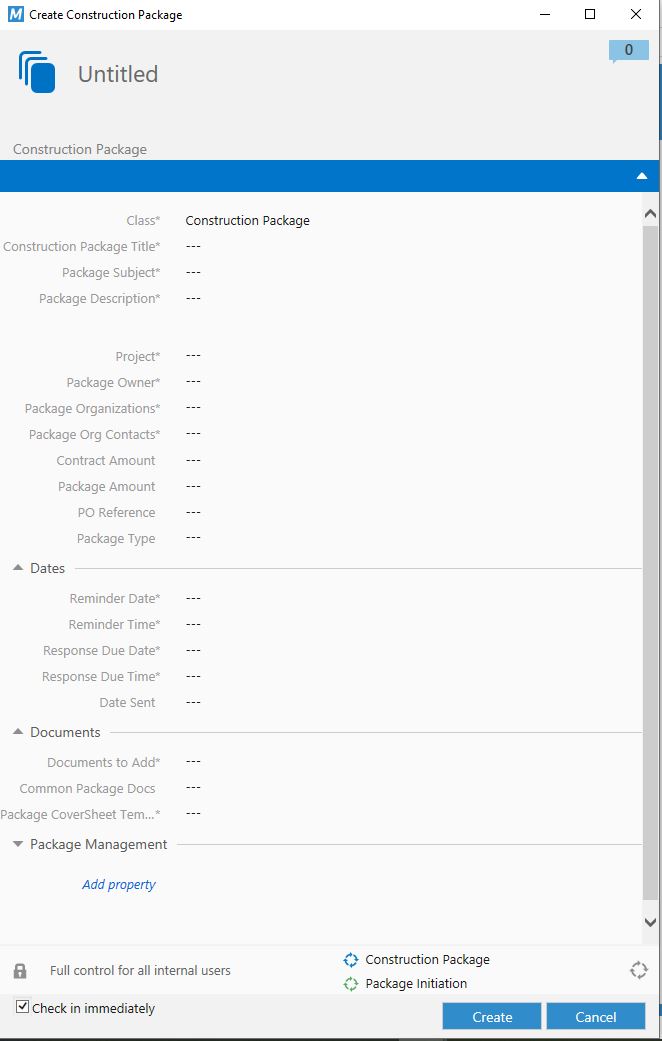
The Construction Package also contains properties in the Package Management property group that track overall status of the Construction Package. Each property on the Construction Package is described below.
Only members of the Package Manager group are allowed to create, update and cancel Construction Packages.
Creating Construction Packages
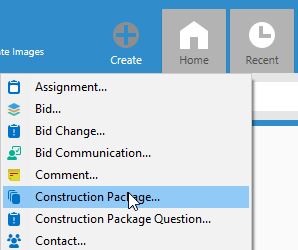
Construction Packages are created using standard M-Files functionality. Click the Create option and select Construction Package from the menu.
Package Information
The Package Information is broken down into several metadata groups for easy organization. Each bit of metadata is discussed in detail below.
- Class - This is the M-Files object class and it must be set to Construction Package. This defines to the system that the object being created is a Construction Package.
- Package Title - The title of the Construction Package is used for identification purposes. It will be shown on all Views, Reports and on the Subcontractor Portal.
- Package Subject - By default, this property is used when sending selected outbound e-mails, such as Package Cover Sheets.
- Package Message - By default, this property will be used as the body of the Package Cover Sheet outbound e-mail.
- Project - This is the Project that the Construction Package is assigned to. For more information on Projects see the Construction Management User Guide.
- Package Owner - The Package Owner is the person responsible for the Construction Package. This person will get M-Files Assignments when there are communications and when the Construction Package closes.
- Package Organizations - This is the list of Organizations that will be participating in the Package Organization process on the Construction Package.
- Package Organization Contacts - For each Organization at least one Contact must be selected. These contacts will receive all communications regarding the Construction Package.
- Contract Amount - This property is automatically set by the system if a Package is created from a Contract. It is used for reporting purposes.
- Package Amount - This property indicates the Amount of the total Contract that is allocated to this particular Package.
- PO Reference - This property is used to store a reference to Purchase Order numbers if desired and is manually filled in.
- Package Type - The Package Type property provides a way for an organization to designate between different types of packages that may need to be communicated to various subcontractors. For example, an Engineering package may have different processes than an RFI. The types can be customized by updating the Package Type value list in M-Files.
Dates
There are two important Date/Time settings within the system: Reminder Date and Response Due Date.
- Reminder Date - On this date a Reminder e-mail will go out to all subcontractors who have not yet marked their Package Complete.
- Reminder Time - The time specified here dictates when in particular on the Reminder Date, the Reminder e-mail will be sent to the subcontractors.
- Response Due Date - This is the day the Packages are due. At 12:01 AM on the Response Due Date, a Final Notification e-mail will be sent to all subcontractors.
- Response Due Time - At this time an assignment will be made to the Package Owner to indicate that the Construction Package should be reviewed and closed.
- Date Sent - This property is filled in by the system and always contains the last date either a Reminder or Response Due message was sent.
The exact time that messages get sent and Construction Packages close is usually within the minute specified time but may vary based on system resources.
Documents
The Documents metadata group contains references to all documents that will be included within the Construction Package.
- Documents To Add - This is a list of documents from the Project that will be included in the Construction Package. To be included a document must reference the Project on its metadata card. Any type of document may be included in this list.
- Common Package Documents - This list of documents contains only documents which have the Common Package Document class. These documents may include things such as corporate safety and legal requirements. The intent of these documents is to be reused across Projects and all Construction Packages.
- Package Cover Sheet Template - The Package Cover Sheet Template will be used to send personalized Package Cover Sheets to each subcontractor on the Construction Package. The system will generate a separate instace of this document for each Organization.
Package Management
The Package Management metadata group is collapsed by default. It contains several properties that are maintained by the system throughout the Construction Package lifecycle.
- Total Packages - This is the total number of Packages created for the Construction Package.
- Open Packages - This is the total number of Packages that have yet to be completed for the Construction Package.
- Construction Package Number - Each Construction Package is assigned a number that automatically increments. The Construction Package Number is unique to the Project. Each Project tracks its own Construction Package numbers.
Construction Package Workflow
When the Construction Package is created it will automatically go into the Construction Package workflow and enter the Construction Package Initiation state. In this state, all information on the Construction Package can be edited, including adding and removing Subcontractors, Contacts, and documents.
Updating Construction Packages
Updates to a Construction Package must be handled in a prescribed manner based on where the Construction Package is in its lifecylce. The list below outlines how changes are handled for each workflow state
-
When the Construction Package is in the Construction Package Initiation state, all information originally entered on the metadata card including Organizations, Contacts and Documents may be updated. Updating the Construction Package after Packages have been created and after they have been sent involve a more controlled change process. Following are the rules for how to make changes at each state in the Construction Package process.
-
Packages Created - After Package have been created but prior to sending the Packages the following rules apply
- Changes to Organizations or any documents require that the Package get recreated. This is done by changing the workflow state on the Construction Package to Recreate Packages.
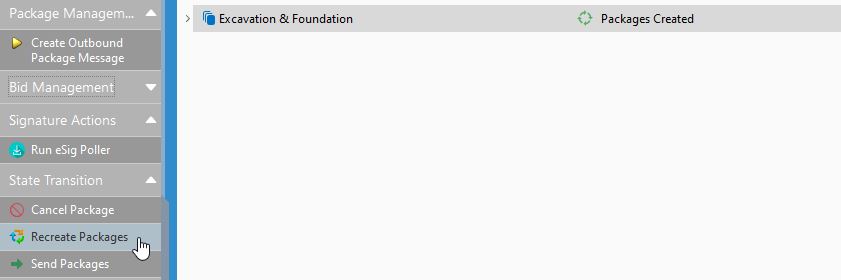
There is no limit to the number of times Packages can be recreated.
-
Construction Package Open For Response, Package Reminders Scheduled, Package Reminders Sent, Final Package Notifications - In any of these states the following rules apply
- Changes to Organizations - Added Organizations will have a Package automatically generated for them. Organizations that get removed will have their Package set to a state of Organization Removed. If the Organization is added back in at a future time, the Package will be reactivated and any communications or documents that previously existed will be preserved.
- Changes to Reminder Date & Time - If a Reminder has been sent and the Reminder Date is moved into the future, a second reminder will not be sent. In all other cases the Reminder will go out on the new date and time specified.
- Changes to Response Due Date & Time - If the Final notification has been sent or the Construction Package is already closed a second notification will not be sent and the new Response Due date will not be respected. If the Response Due Date and Time has not occured and the date is changed, the Final Notification and Construction Package closure will occur on the new date and time. If the new Response Due Date is in the past, the Final Notification and Construction Package closure will occur immediately.
- Changes to Documents - Changes to documents must be handled through the Package Change Process outlined below.
- Changes to Contacts - Contacts may be added or removed. A contact must be present for each Organization on the Construction Package. Future notifications will be sent based on the updated Contact list. E-mail notifications that have already been sent will not be resent to newly added Contacts.
When a Construction Package Closing Date is changed, all subcontractors receive an e-mail notification that the date has been changed.
Canceling Construction Packages
In the event that a Construction Package needs to be canceled for any reason, this can be done at any point in the process. To cancel the Construction Package, change the workflow state of the Construction Package to Cancel Package. This will cause a notification of the cancelation to be sent to all subcontractors and the workflow state for all Packages on the Construction Package will automatically be changed to Package Canceled.

Canceled Packages do not appear on the subcontractor portal.
Managing Packages
A Package is created for each Organization on the Construction Package to store all documents and communications for that Package. The Package will also contain references to the documents on the Construction Package.
Creating Packages
Creating Packages is done by changing the workflow state on the Construction Package from Package Initiation to Create Package.
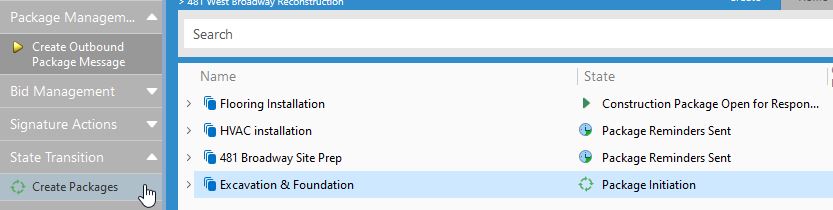
Creating Packages performs the following important functions.
- Creates a Package for each Organization on the Construction Package and fills in all metadata for the Package.
- Creates a Package Cover Sheet Document for each Organization on the Construction Package using the Package Cover Sheet Template.
- Creates a "frozen in time" copy of the documents referenced on the Construction Package to insure that all Package Organizations see the exact same version of the Package documents regardless of when they access the content or how many revisions get made in the future.
Once Packages have been created, changes to Organizations and Documents require that Packages get recreated prior to being sent.
Reviewing & Updating Packages
After Packages have been created, there is an opportunity to review and potentially update information on the Construction Package. There are two primary updates that can occur at this point.
- Construction Package Updates: These changes will require that Packages get recreated. See Updating Construction Packages above.
- Package Cover Sheet Updates: The automatically generated Package Cover Sheet documents may be updated with additional information prior to sending the Construction Package. There is no special processing involved. The documents can be opened, edited and saved as needed. Package Cover Sheet Documents must be in the Approved workflow state in order for Construction Packages to be sent.
Recreating Packages
There may be occasions after Packages have been created for a Construction Package, but prior to the Construction Package being sent, that revisions to some of the documents referenced by the Construction Package make it necessary to update the "frozen in time" copy of the documents that are on the Packages. To refresh all of the Packages with the lastest versions of the documents, change the workflow state of the Construction Package to Recreate Packages.
This will cause all Packages on the Construction Package to be completely recreated.
Sending Packages
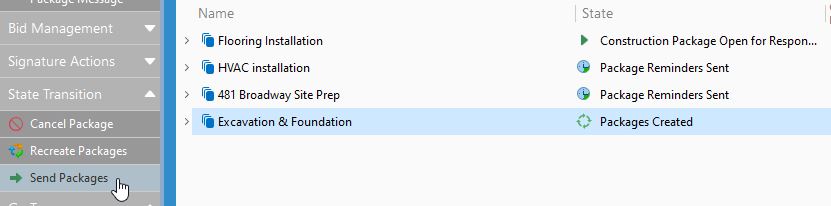
Once the Construction Package and Packages have been reviewed internally and are ready to be sent, the Construction Package can be sent by changing the state of the Construction Package to Send Construction Package.
Complete Construction Package
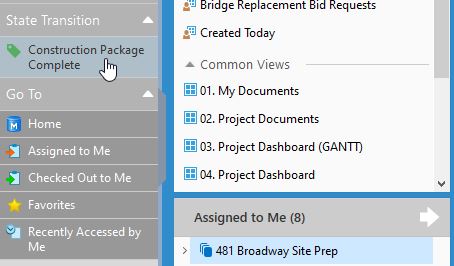
Once the Response Due Date & Time has been passed, the Construction Package will automatically move to a state of Construction Package Closed and an Assignment will be created for the Package Owner. The Construction Package will remain in this state until it is manually changed to a state of Construction Package Complete. This state is meant to indicate that any manual processes and reviews have been completed.
Package Communications
Package Management allows for both outbound and inbound communications at various points throughout the process.
Outbound Communications
Outbound Communications are used to send communications to one or more Organizations. Outbound Communications are created as Objects in M-Files using the Create menu option.

The Outbound Communications metadata card contains all properties necessary for an outbound message.
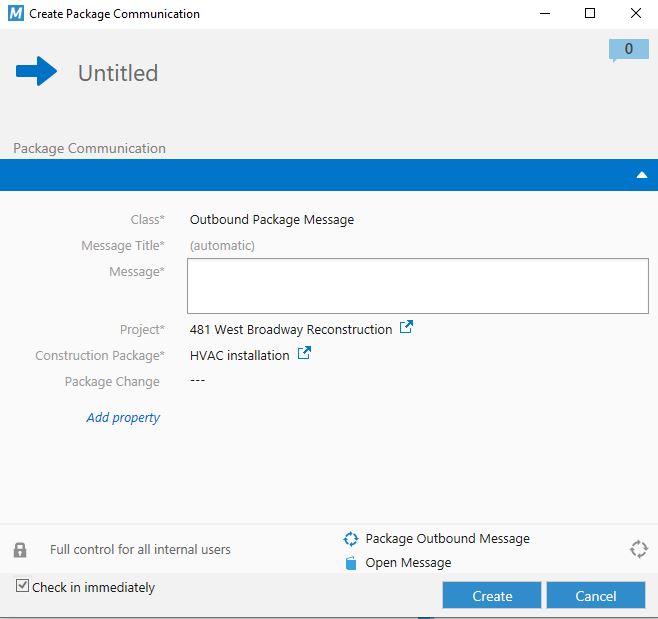
- Message - The message text for the outbound message.
- Project - The Project that the message is associated to.
- Construction Package - The Construction Package that the message will be sent to.
- Package Change - If specified the Package Change gets associated to the message and will be referenced.
All Outbound Communications go through a workflow which facilitates review and sending the message. Once created the Outbound Communication will be in the Open Message state. To send the message change the state to Send Message.

Outbound Messages have tremendous flexibility. There are NOT restrictions preventing Outbound messages from going to combinations of Construction Packages and Packages. Please excercise caution when sending messages across multiple Construction Packages.
Inbound Communications
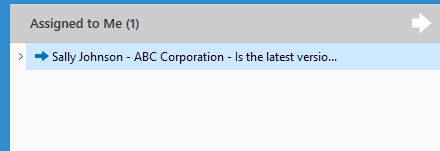
Inbound Communications are created by Subcontractors in the Portal Interface. See Portal Interface below. When Inbound Communications are received an Assignment is created for the Package Manager who can review those Communications.
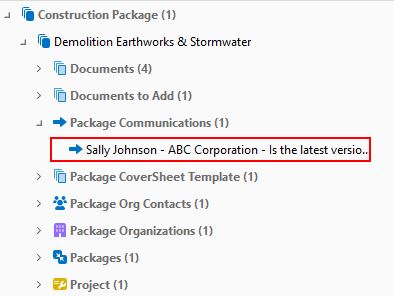
The Inbound Communications will also be visible within the M-Files 360 Degree View within the Package Communications grouping.
The Inbound Communication information is created automatically by the Portal when the Subcontractor creates the message.
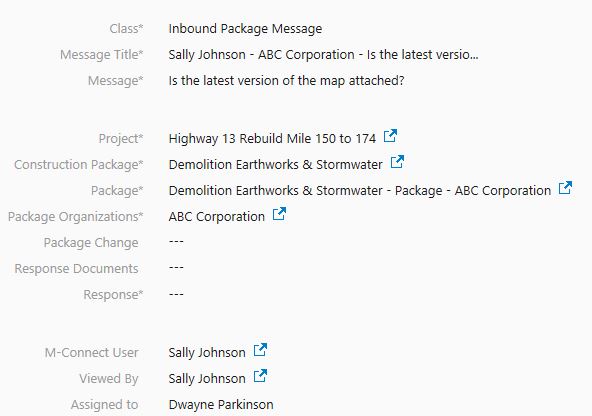
Three properties are used to respond to the Inbound Communication.
- Package Change - In cases where there is a Package Change or multiple changes that should be referenced by the response to the Inbound Communication, select the Package Changes that apply.
- Response Documents - This property contains a list of Project documents that are attached to the response to the Inbound Communication.
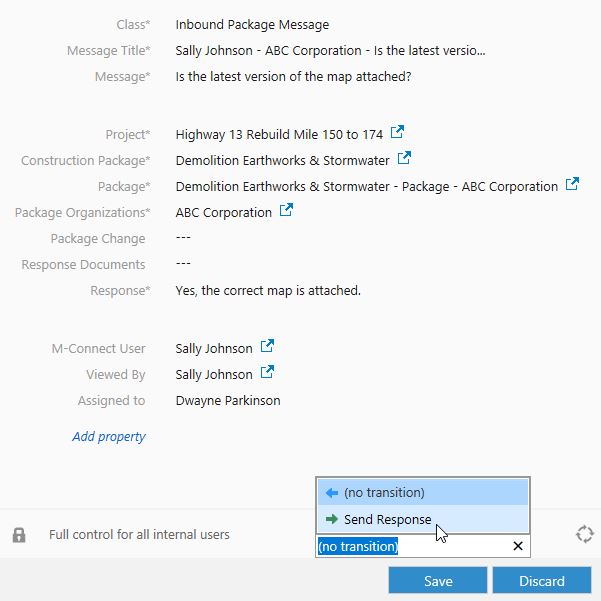
- Response - This text field contains a free form message that will be the text response to the Inbound Communication.
To send a Response, once the Response property (and optionally Response Documents and Package Change) has been filled in, change the state of the Inbound Communication to Send Response
Package Changes
Changing documents within a Construction Package must be done in a very controlled manner to insure every subcontractor is informed of the change and the documents are updated to reflect the change. The Package Change process is to Create, Review and Apply the changes. Optionally, an Outbound Communication can be created for the Package Change and sent to the subcontractors .
Construction Packages can be changed until the Construction Package is Closed Pending Award.
Create Package Change
Creating a Package Change can be done two ways. The first is to use the Create Package Change from the M-Files menu. When creating Package Changes in this manner all metadata must be provided as specified below.
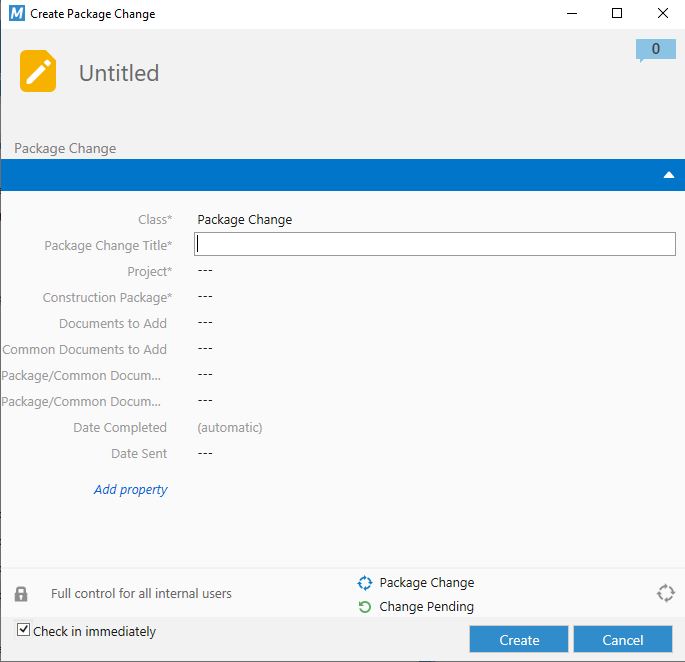
Another way to create a Package Change is to use the Create Package Change Action in the M-Files Action bar. The Package Change Action will be available when a Construction Package which is still open and able to be changed is highlighted. Package Changes created this way will automatically populate metadata related to the Construction Package making the process of creating the change more efficient and accurate.

M-Files will prompt you to "Confirm Auto-Fill" with Documents To Add. Select NO.
The following properties are part of a Package Change.
- Package Change Title - This is the title of the Package Change for reference and subsequent communication to the subcontractor.
- Project - The Project that the Package Change applies to.
- Construction Package - The Construction Package that this Change will be applied to.
- Documents To Add - This is a list of Project Documents that will be added to the Construction Package as part of this Package Change.
- Common Documents To Add - This is a list of Common Documents that will be added to the Construction Package as part of this Package Change.
- Package/Common Documents To Update - This is a list of Package & Common Documents on the Construction Package that have a newer revision and need to be applied across all Packages on the Construction Package.
- Package/Common Documents To Remove - This is a list of Package & Common Documents on the Package Pacakge that will be removed from all Packages on the Construction Package.
- Date Completed - This is the date the Package Change is Applied to the Construction Package see Applying Changes To Packages below. It is set automatically by the system and becomes visible after the Package Change has been created.
- Date Sent - If a Package Communication is created and sent which references this Package Change, the Date Sent will be automatically set once the Package Communication has been sent.
Process Package Change
Once a Package Change has been created, the changes can be reviewed and then ultimately Processed which applies the change to the Construction Package.
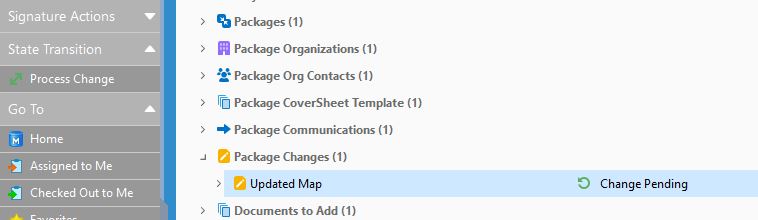
Moving the Package Change to this workflow state will cause all of the documents on the Package Change to be updated across all Packages on the Construction Package.
Create Package Communication
Once the Package Changes have been applied, there is an optional step to send a Package Communication to inform Subcontractors that the Construction Package has been changed. See Package Communications above.
M-Files Views
By default the Package Management solution is located within the Construction Management View in M-Files. For more information about creating and maintaining views please reference the M-Files User Guide. The View structure below outlines the default Views provided within the system and their purpose.
- Construction Packages - Contains all internal Package Management Views
- Open Construction Packages - Shows a list of Construction Packages that are open (i.e. not Canceled or Completed) and is grouped by Project.
- Closed Construction Packages - Shows a list of Construction Packages that are not open (i.e. Canceled or Completed) and is grouped by Project.
- All Construction Packages - Shows all Construction Packages and is grouped by Project.
- Projects - Contains a list of all Projects within the system
- Configuration Files - This View contains separate Views for each of the types of Configuration Document Files that are used by the system
- E-Mail Templates - See E-Mail Templates
- E-Mail Template Images - See E-Mail Template Images
- Package Cover Sheet Templates - See Package Cover Sheet Templates
- Common Package Documents - See Common Package Documents
- Organizations - Contains a list of Organizations within the system.
- Orgs By Trade - Lists Organizations based on the Trade associated to that Organization.
- All Organizations - Lists all Organizations in the system.
- My Packages - This View is used by the Portal Interface to determine what is visible to the subcontractor. Each View shown here will be available to the subcontractors, however, they will only see items in the list that belong to their organization.
- Pending Packages - Packages that are Pending are those in the following workflow states: Accepted - Preparing Response, Package Closed Pending Award, Package Documents Uploaded, Package Declined, Package Initial Review, Package Opened and Package Response Complete. In the Portal these requests are restricted to the Organization of the signed in user.
- Awarded Packages - This is a list of Packages which have been set to the Package Awarded state. In the Portal these requests restricted to the Organization of the signed in user.
- All Packages - This is a list of all Packages. In the Portal these requests are restricted to the Organization of the signed in user.
Portal Interface
Subcontractors access the Package Management system via the Portal interface.
An M-Connect Portal user must be assigned to an Organization in order to have access to Package information related to that Organization. See the Construction Management User Guide.
Packages Tab
The Packages Tab shows the same information as the View defined in My Views. See M-Files Views above. Changing the View in M-Files and saving those changes as common display settings will update the information in the Package Management Tab.
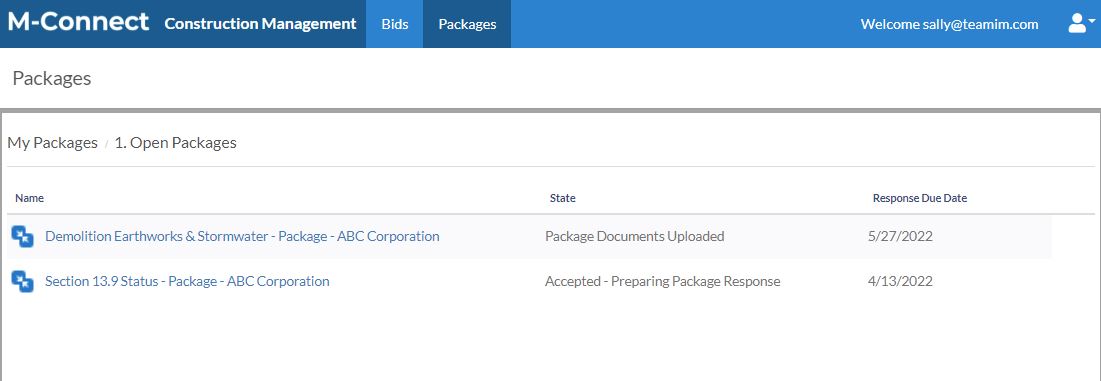
Clicking on any Package listed will open the Package Management interface.
Package Management Overview Screen
The initial Package Management Interface displays the Package Management Overview screen.
When the subcontractor opens a Package within the Package Management screen for the first time, the workflow state of the Package automatically changes from "New Package" to "Package Initial Review" to indicate that the subcontractor has viewed the information even though they may not have Accepted or Rejected the Package yet.
There are five sections within the Package Management screen shown below.
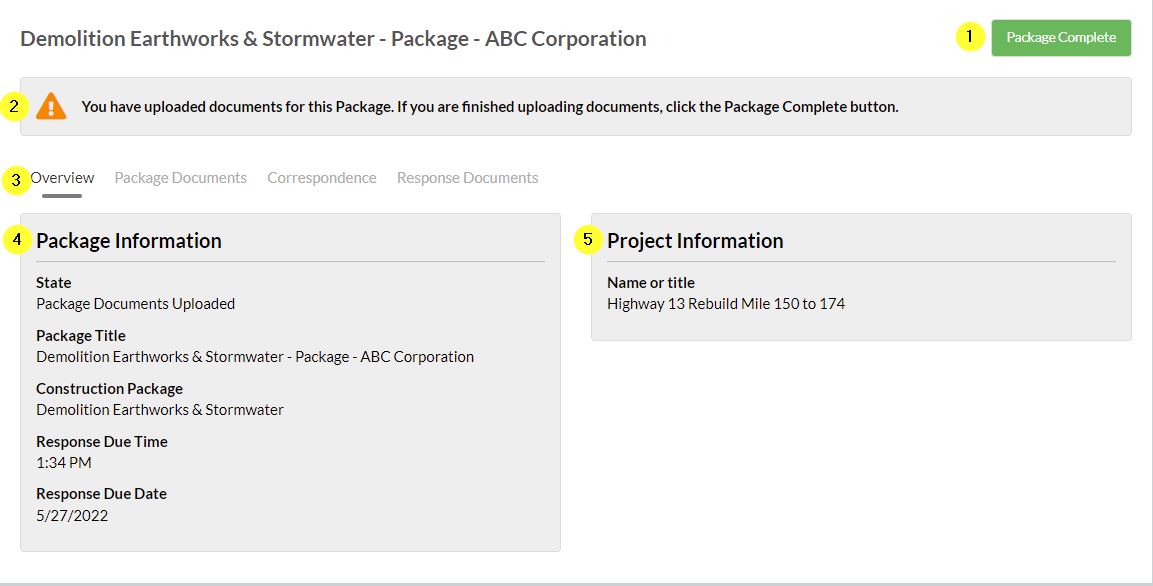
- Action Buttons - These buttons determine what actions are available to the Subcontractor at any given point in the Package lifecycle. Not all buttons are avialable at all times.
- Accept Package - Accepting the Package changes the state of the Package to Initial Review and allows a subcontractor to provide correspondence and upload response documents.
- Decline Package - Declining a Package notifies the Package Owner that the subcontractor has declined the Package. This creates an assignment
- Package Response Complete - Indicates that all response documents have been updated.
- Reopen Package - In cases where the subcontractor needs to add information to a Package that has been completed, the Package can be reopened provided the Response Due date has not been met.
- Information Panel - This area of the screen will contain information telling the subcontractor about the Package process and how they should proceed.
- Functional Tabs - Each functional tab features and functions that are unique.
- Package Information - This panel shows information from the Package. The amount of information shown is configurable. See the Package Management Administrator Guide.
- Project Information - This panel shows information from the Project associated to the Package. The amount of information shown is configurable. See the Package Management Administrator Guide.
Package Documents
The Package Documents tab becomes visible to the subcontractor after they have clicked the Accept Package button. This tab provides the ability for the subcontractor to review and download all documents associated with the Package.
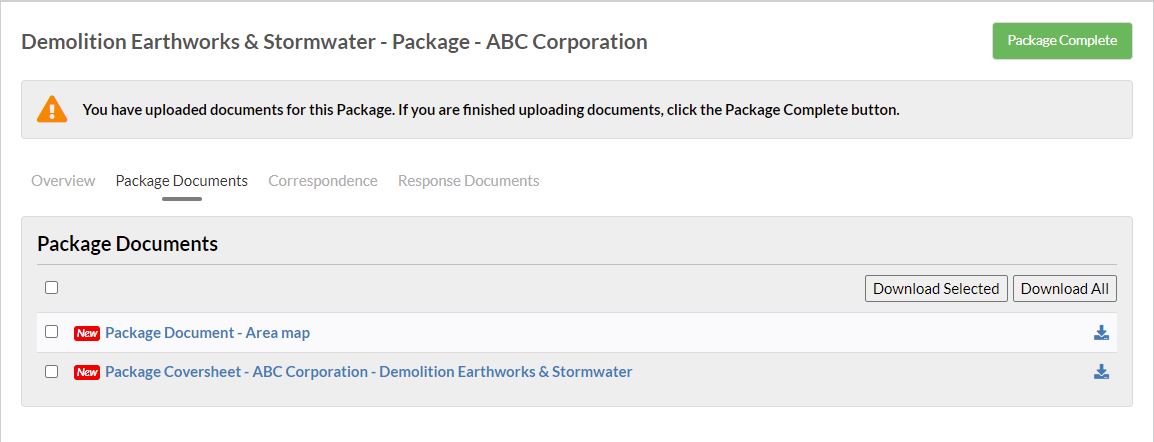
- Select File Checkboxes - Checking the box next to a file or files will choose that file or files for download. The select box at the top will select all Package Documents for downloads.
- Package Document List - This is a list of all Package Documents. Documents are flagged as New until a subcontractor views them. If documents get added or updated with a Package Change, those documents also get flagged as New to indicate that they have not yet been viewed.
- Download Buttons - These buttons allow the subcontractor to download all files or selected files.
- Download File Icon - Clicking on this icon allows the subcontractor to easily download an individual file from the list.
Viewing Package Documents
Package documents can be viewed directly from the Portal by clicking on the document title. See Document Viewer below for Document Viewer features.
Package Correspondence
The Package Correspondence tab becomes visible to the subcontractor after they have clicked the Accept Package button. This tab provides the ability for the subcontractor to send and receive communications related to the Package.
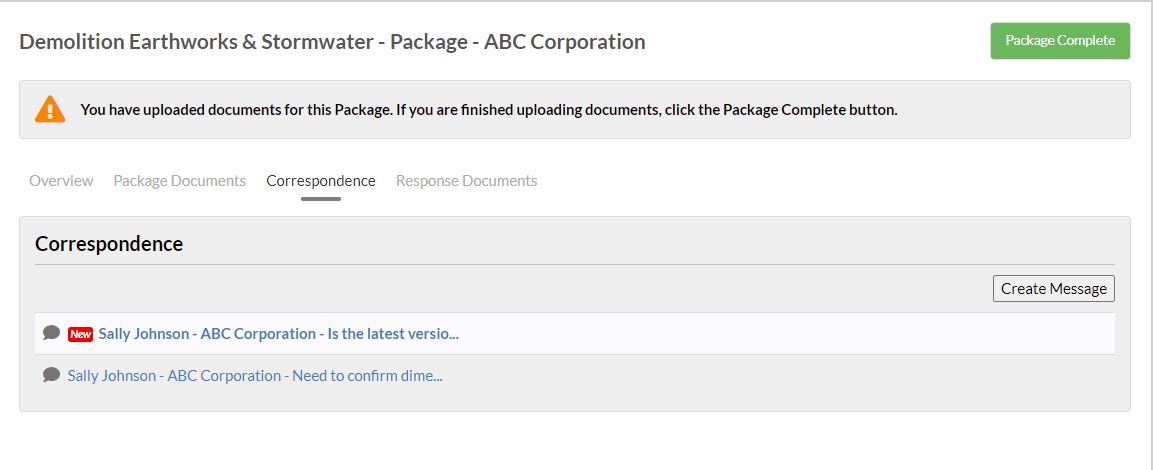
Each message title contains the name of the person who created the message and the organization along with a portion of the message that was sent. Messages that have replies and have not been viewed, will be bold and have the New icon. Clicking on the message title will expand the message to show the details of the message.
- Create Message - Provides the ability to create a message and send it to the organization. See Create Message below.
- Message List - The message list provides a summary of messages sent from the subcontractor organization.
- Response Documents - If the message has a response and that response had any documents attached, a section for Response Documents will be visible.
- Attachments - When creating a message, files can be attached. This section will contain a list of files that were attached to the message when it was created.
- State - The State indicates where the message is at in its lifecycle. It could be an Open Message, have a Repsonse Sent or have a Response with Package Change. See Package Change above.
- Message - This is the text of the original message that was sent from the subcontrator.
- Response - This is the text of the reponse that was sent to the subcontractor.
- Download - In cases where a Response Document has been uploaded to the message, the Download icon allows the subcontractor to Download that document to their local PC.
Create Message
Clicking the Create Message button from the Package Correspondence tab provides the ability for a Subcontractor to send a message including attachments. The incoming message creates a special message object which gets assigned to the person assigned as the Package Manager on the Construction Package.
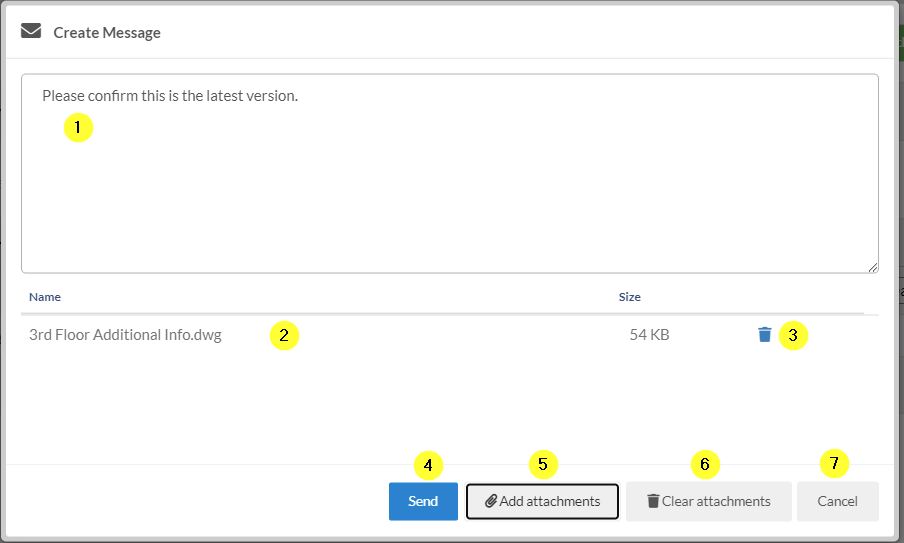
- Message Text Area - This area contains the text of the message that will be sent.
- Attached Files - A list of files that have been attached to the message appear here.
- Delete Attachment - The Delete Attachment feature allows files that have been attached to the message to be deleted.
- Send - Sends the messsage and closes the Create Message window.
- Add Attachments - Opens a standard dialog box which allows documents to be selected and attached to the message.
- Clear Attachments - Removes all attached files simultaneously.
- Cancel - Cancels the message and closes the Create Message window without sending the message.
Document Viewer
The M-Connect Portal Interface includes a powerful and flexible Document Viewer that is capable of previewing many types of documents without requiring the end user to install software on their local computer. The full list of supported file types is available here The Viewer includes a View screen and a Search screen.
Document View Screen
The following features are supported in the Document View Screen.
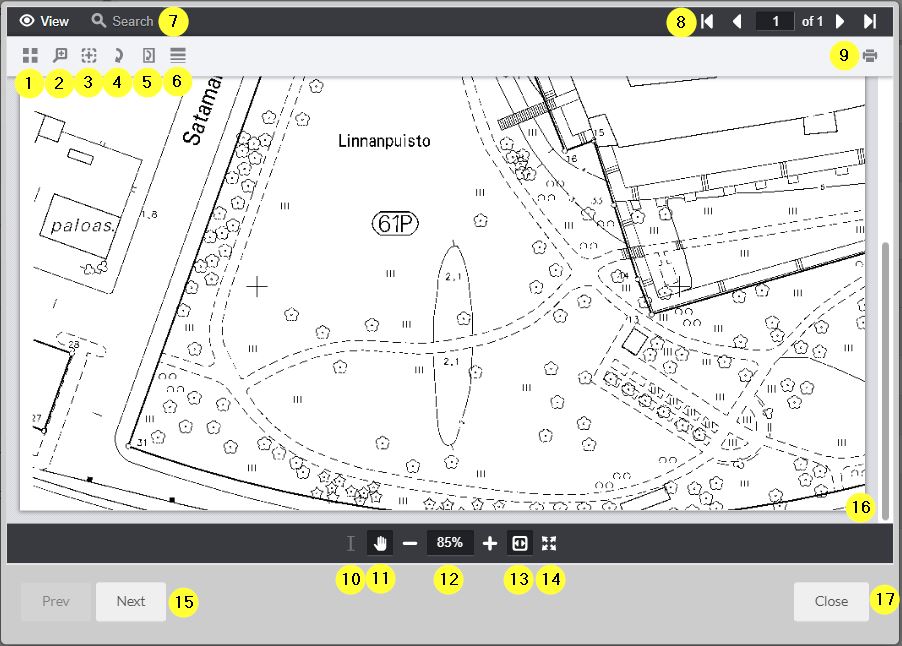
- Thumbnails - Toggles on and off a Thumbnail view of that is helpful for documents with many pages. The user can scroll through the pages and select the page from the thumbnail to view.
- Magnifier - Toggles on and off a magnifier tool. With this tool on, when the end user clicks anywhere on the document, that section of the document is magnified.
- Rectangle Zoom - Toggles on and off a rectangle zoom tool. This allows the end user to zoom in on a specific part of the page. The end users draws a rectangle on the page and when complete the viewer will zoom in so the rectangle becomes the full page.
- Rotate Document - This tool rotates the document 90 degrees with each click. All pages within a multi-page document are rotated simultaneously.
- Rotate Page - This tool rotates the current page 90 degrees with each click while not impacting any other pages in the document.
- Image Tools - This displays the Image tools that allow you to adjust the Sharpening, Gamma and Line width within image files. Moving the sliders will cause the viewer to adjust the image file accordingly. In some cases these tools can make scanned documents and/or photographs more legible.
- Search Tools - Clicking on Search toggles to the Document Search Screen (see below).
- Page Navigation - The Page Navigation allows you to move one page at a time, to the first page, to the last page or you may enter a specific page number.
- Print - This button opens the Print dialog box on the end users computer and allows printing of the document.
- Select Text - This tool allows text from within the document to be selected. Using keyboard shortcuts (CTRL+C in Windows) the selected text can be copied and pasted (CTRL+V) into other documents.
- Scroll - When selected, the hand tool provides a quick way of moving the document within the viewer. Click anywhere on the document and hold down the mouse button and then move the mouse to move the document within the viewer.
- Zoom Control - The Zoom Control provides the ability to zoom in or out by click the + or - respectively. The viewer will zoom in and out in preset amounts. Clicking on the Zoom Percentage reveals a menu with all of the preset zoom levels. Selecting a zoom level from the menu will cause the viewer to zoom in or out to that level.
- Fit Content - The Fit Content tool zooms in so the document width is exactly the same as the width of the viewer.
- Full Screen - The Full Screen tool causes the viewer to hide the buttons and use that area for displaying the document.
- Next & Previous - The Next and Previous buttons allow the end user to quickly navigate through the Documents listed in the Portal with a single click. Each click opens a new document inside the viewer.
- Scroll Bars - Depending on the size of the document and the level of zoom scroll bars may be visible. These scroll bars provide the ability to move the document within the viewer.
- Close - Closes the Document Viewer.
Document Search Screen
The following features are supported in the Document Search Screen. Initially the search results pane is not visible. When a search is performed, the Search Results Pane will become visible.
The search tool will only search text based documents such as Full Text PDF and MS Office files. Scanned images, pictures, drawings, etc. cannot be searched.
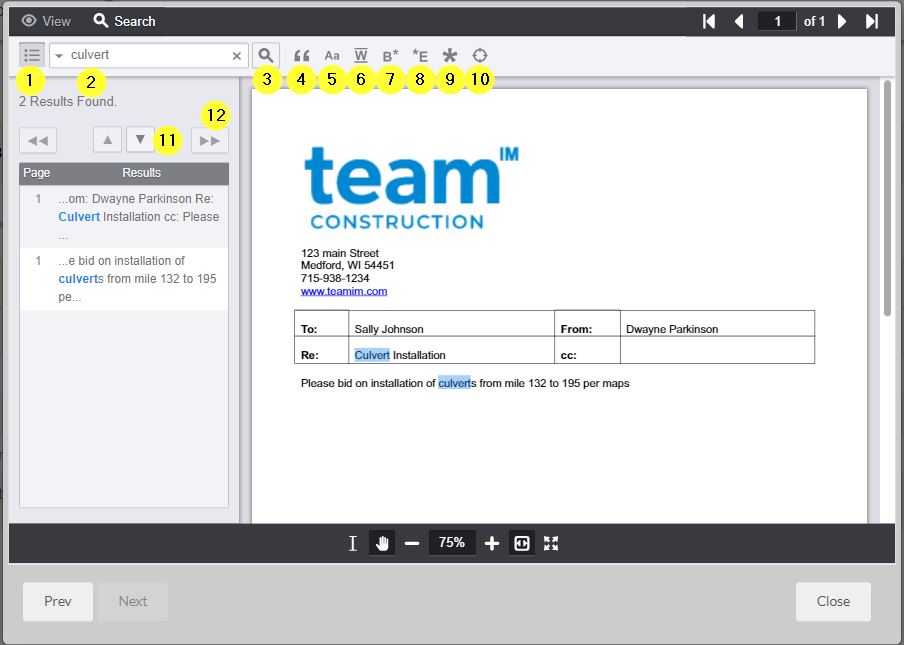
- Toggle Search Results - When a search is performed, the search results appear on the left side of the Viewer in a special search results pane. This button toggles the search results pane on and off.
- Search Term - The term or phrase to be searched. Matches will be highlighted.
- Search - The magnifying glass searches the document for the text that has been entered.
- Exact Match - The Exact Match button insures that only exact matches are returned. In the sample above, "culvert" was searched but matches for both culvert and culverts were returned. An Exact Match search will only return cases where the word matches exactly.
- Match Case - When this feature is enabled, only words that match the exact upper and lower case of each letter will be return.
- Whole Word - Whole word search will return only those matches where the whole word matches the search text.
- Begins With - This search will only return matches where words start with the search text provided.
- Ends With - This search will only return matches where words end with the search text provided.
- Use Wildcards - This features allows the use of wildcards in the search. Standard wildcard characters include * to look for any number of charcaters and ? to look for a specific number of characters. Searching the document above for ma* will return results for "main" and "maps" however, searching for m?i* will return only main since the match must include an m, any character and then an i, followed by any number of characters.
- Proximity Search - A proximity search returns results when multiple search terms are close to each other. This requires entering search terms in a specific way. For example, if a search is "culvert mile ~2" this means the search should return matches where the word culvert and mile are within two words of each other.
- Next/Previous Result - These arrows move through the list of search results one at a time highlighting the result within the document.
- Next/Previous Page of Results - In cases where there are many results, these double arrow buttons move between the pages of results.